





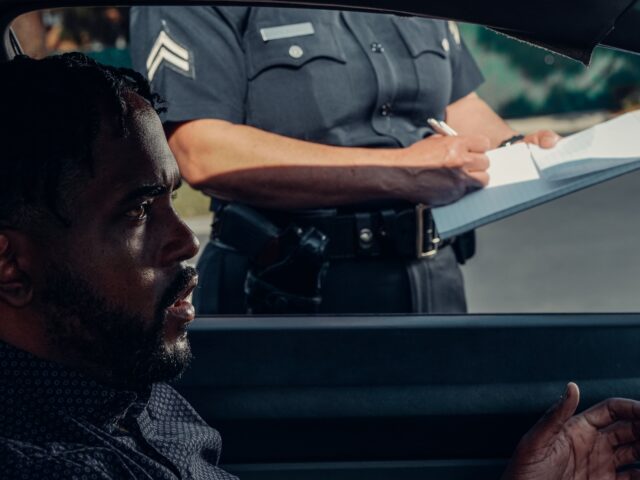
We have all seen the viral videos: a driver gets pulled over, cracks their window an inch, and hands their license through the gap while arguing with an officer about their constitutional rights.
This raises an essential question for motorists in Nevada: Do you legally have to roll your window down for police during a traffic stop?
THE SHORT ANSWER IS YES, to be safe. While you can attempt to identify yourself and hand documents over through a partially opened window, if the officer states that he needs you to roll it down for his investigation or for officer safety, your best move is to comply. Refusing to do so can quickly result in a misdemeanor charge for Obstructing a Public Officer and a ride to the local jail.
This is why those TikTok videos of people yelling at officers that they know their rights are just videos of people talking themselves into an arrest.
I’ve represented enough people in criminal court to know that very few of them expected a routine traffic stop to end in handcuffs. More often than not, the arrest happened because a relatively minor encounter escalated after someone refused a lawful command or argued with the officer.
NRS 197.190 Obstructing public officer. Every person who…shall willfully hinder, delay or obstruct any public officer in the discharge of official powers or duties, shall…be guilty of a misdemeanor.
Can I refuse to roll down my window because of the Fourth Amendment?
Many drivers believe the Fourth Amendment gives them the right to keep their window rolled up during a traffic stop. It does not.
The Fourth Amendment protects individuals against unreasonable searches and seizures. However, once police have lawfully stopped your vehicle based on suspicion that a traffic offense has occurred, even if police are ultimately mistaken about that, the stop itself is considered a lawful seizure. During the stop, police are allowed to take reasonable steps to investigate the traffic violation and ensure officer safety.
That includes requesting your driver’s license, registration, and proof of insurance, asking you to lower your window enough to communicate, and ordering you out of the vehicle altogether. The United States Supreme Court has repeatedly recognized that these limited intrusions are generally reasonable under the Fourth Amendment because traffic stops are inherently dangerous encounters for both motorists and law enforcement officers.
What if it is not a lawful traffic stop?
I think about that old movie, Road House, with Patrick Swayze, where he was training his bouncers to be nice until it is time to not be nice. One of them asks, “How will we know when that is? Swayze answers, “You won’t! I’ll let you know!” That is for your lawyer to address later, in court. The roadside is absolutely not the proper place to litigate the legality of a traffic stop. If you believe an officer violated your Fourth Amendment rights during a traffic stop, the appropriate remedy is typically to challenge the legality of the stop or the officer’s conduct later in court through a motion to suppress or other legal proceedings, not by refusing commands during the stop itself.
Practical Tip: Always ask the officer if you have a choice, and politely make it clear that you are complying with the officer’s instructions because you are being told you do not have a choice, and that you are complying while also refusing to consent. Key word is politely. This helps to preserve any constitutional challenges. If the officer acted unlawfully, an experienced criminal defense attorney can later ask the court to suppress illegally obtained evidence or dismiss charges where appropriate.
Can I just say my name through a cracked window or can I just hold my license up to the closed window?
No. You cannot simply state your name or press an ID card against a closed window; you must actively facilitate the surrender of the physical documentation.
Nevada law requires you to physically hand over drivers license, registration, and insurance.
When you are pulled over in Nevada, you must roll your window down enough to physically surrender your documents rather than simply displaying them through glass:
-
Identify Yourself: Under NRS 171.123(3), any person temporarily detained under reasonable suspicion that a traffic offense has been committed “shall identify himself or herself.”
-
Surrender Driver’s License: Under NRS 483.350, a driver must carry a physical driver’s license and physically present it upon demand by law enforcement.
-
Surrender Registration & Insurance: Nevada law explicitly mandates that a driver must, upon demand, physically surrender their vehicle registration (NRS 482.255) and physical or electronic proof of insurance (NRS 485.187) for examination.
Can I hand my license and registration through a cracked window?
The “Cracked Window” Reality: What the Courts Say
Many drivers think a cracked window is a clever legal loophole to protect their privacy. However, in the real world, it often backfires. When a driver insists on keeping the window up, the legal battle isn’t about a specific “window statute”—it centers on whether the failure to roll your window down constitutes criminal obstruction.
A Virginia case, Thorne v. Commonwealth, 66 Va.App. 248 (Va. App. 2016), upheld a conviction for obstruction where a woman only rolled her window down 3-4 inches to provide her drivers license and other documents. The officer repeated asked her to roll her window down to test her tint level, but instead of rolling her window down, Shawanda Thorne kept yelling, “I know my rights! You don’t know my rights!” The officer ordered her out of the car, which she also refused. The officer told her he would arrest her for obstruction if she did not roll the window down, and she responded, “Do what you gotta do.” About nine minutes later, she ended up rolling her window down when another unit arrived. However, that 9 minutes was more than enough time for the Virginia Court of Appeals to uphold the conviction.
Can police order me out of the car on a traffic stop?
Yes. While you may be able to comply by handing documents through a cracked window instead of rolling it all the way down, an officer can always order you and your passengers to exit the vehicle, so giving an officer motivation to do that will defeat your entire gameplan of just barely rolling down the window.
The Catch-22 of Refusal: Pennsylvania v. Mimms
The moment the officer switches tactics and orders you completely out of the car under Mimms, you have zero constitutional ground to refuse. Refusing to exit provides a clear path for an officer to make a lawful arrest for Obstructing a Public Officer.
This is because in Pennsylvania v. Mimms, 434 U.S. 106 (1977), the U.S. Supreme Court ruled that police can always order the driver and passengers out of a vehicle at a routine traffic stop as a matter of course, without needing any any additional justification or suspicion.
The Court extended this same bright-line rule to passengers twenty years later in Maryland v. Wilson, 519 U.S. 408 (1997).
The judicial reasoning is straightforward: (1) a traffic stop is already a lawful detention; (2) ordering the occupants out of the vehicle is considered a “de minimis” (minimal) additional intrusion on their liberty; and (3) on the other side of the scale, roadside stops are inherently volatile and dangerous for law enforcement.
And if you notice in the Virginia case, Shawanda Thorne also refused to exit. That in itself is enough for an obstruction charge.
The Ultimate Takeaway:
While you can attempt to identify yourself and hand documents over through a cracked window, if the officer states that he needs you to roll it down for his investigation or for officer safety, your best move is to comply. Otherwise, you might be turning a simple ticket into a ride to the local jail.
Arrested after a traffic stop in Las Vegas?
Whether you were charged with obstruction, resisting a public officer, DUI, or another offense, the legality of the stop and the officer’s actions may have a significant impact on your case. Contact Moskal Law to discuss your options with a former Chief Deputy District Attorney.
Disclaimer: The information provided in this blog post is for general informational purposes only and does not constitute formal legal advice. Browsing this website or reading this post does not create an attorney-client relationship. If you are facing criminal charges or a rights violation in Nevada, please consult with a qualified criminal defense attorney. Important: This article discusses what is generally the safest course of action during a traffic stop. Every encounter is different, and unusual circumstances may change the legal analysis.
